SEBI PMS Regulations 2026: What Changes for NRI Investors
CA Niraj Thacker
Co-Founder, PMSAIF Partners
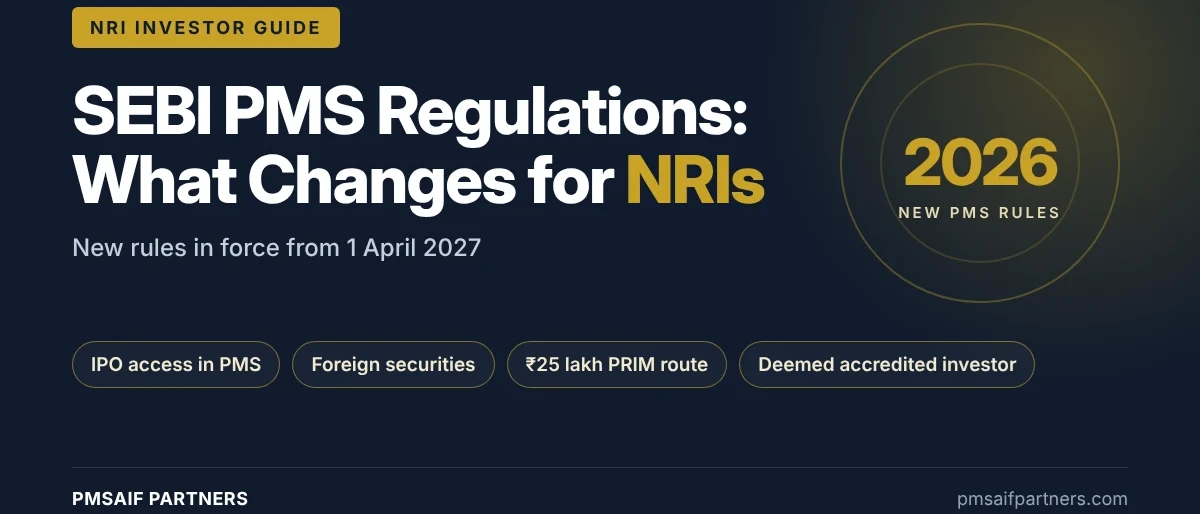
SEBI's new PMS rules start on 1 April 2027. See what changes for NRI investors, what stays the same and what to check before you invest.
SEBI has rewritten the rulebook for Portfolio Management Services (PMS). The new SEBI PMS Regulations 2026 were approved on 24 September 2026, notified on 7 October 2026, and will replace the 2020 rules from 1 April 2027.
If you are an NRI (Non-Resident Indian) who already invests through a PMS, or plans to, you have probably seen headlines about IPOs, foreign stocks and a new ₹25 lakh route. This guide explains, in plain language, what the SEBI PMS regulations 2026 mean for NRI investors: what changes, what stays the same, and what you should check before you invest.
A PMS is a service where a SEBI-registered portfolio manager manages a portfolio of stocks and other securities for you. The securities sit in your own demat account, not in a pooled fund.
Key Takeaway: Nothing changes for your PMS today. The new rules start on 1 April 2027. They give portfolio managers more tools (IPOs, unlisted debt, foreign securities, independent fund managers), and SEBI has also approved "deemed accredited investor" status for all non-residents. The ₹50 lakh PMS minimum stays the same.
Table of Contents
- What Are the SEBI PMS Regulations 2026?
- Key Changes in the New PMS Rules 2026
- What the SEBI PMS Regulations 2026 Mean for NRIs
- The PRIM Route for NRIs in Short
- What Stays the Same for NRI PMS Investors
- Worked Example: Two NRI Investors
- Checklist Before You Invest
- Frequently Asked Questions
- Conclusion
What Are the SEBI PMS Regulations 2026?
The SEBI (Portfolio Managers) Regulations, 2026 are the new rules that every PMS provider in India must follow. They replace the SEBI (Portfolio Managers) Regulations, 2020.
SEBI's goal is to help the PMS industry grow and make the rules simpler. The rulebook shrinks from 70 pages to 33.
Key Changes in the New PMS Rules 2026
What is an independent fund manager in PMS?
An independent fund manager (IFM) is an individual who manages client portfolios in partnership with a registered portfolio manager. The registered PMS stays fully liable for the IFM's work, and you pay fees only to the PMS. If your IFM leaves or is removed, you must be given the option to exit.
Easier paperwork
A new standard Investment Management Agreement includes the authority to operate your demat and trading accounts. The RBI-required Power of Attorney (POA) for your bank account still remains.
What the SEBI PMS Regulations 2026 Mean for NRIs
Most of the new rules apply to all PMS clients, not just NRIs. Here is how each change touches you.
1. Deemed accredited investor status. This is the most NRI-specific change. SEBI's Board approved that every Person Resident Outside India (PROI), as defined under FEMA (Foreign Exchange Management Act), will be treated as an accredited investor. Accredited investors can access certain products and flexibilities meant for experienced investors. SEBI's press release does not give a start date for this change, so check its status with your PMS before relying on it.
2. IPOs inside your PMS. Your portfolio manager can now apply for IPOs on your behalf. For NRIs investing on a repatriation basis through PIS (Portfolio Investment Scheme, the RBI route that lets NRIs buy listed Indian shares), normal PIS and FEMA rules will still apply to these shares.
3. Foreign securities: mainly for residents. SEBI says PMS investments in foreign securities are governed by FEMA and the RBI's Liberalised Remittance Scheme (LRS). LRS is the route resident Indians use to send money abroad. As an NRI, you can usually already invest abroad from your country of residence. So this change mostly helps resident investors. Ask your PMS whether its foreign option is even open to non-resident clients.
4. More choice of managers. With IFMs, a PMS can offer more strategies. That also means more homework on who actually manages your money.
Country-specific angles
US and Canada NRIs should be careful. Under US rules, many foreign pooled funds, including Indian mutual funds and ETFs, can be treated as a PFIC (Passive Foreign Investment Company), which brings complex US tax and reporting. A regular PMS that holds shares directly in your name is often preferred for this reason. If your PMS starts buying mutual funds, ETFs or overseas funds under the new rules, ask how that affects your US filings.
UAE/GCC NRIs mainly need to track India-side TDS (Tax Deducted at Source) and repatriation. UK and other NRIs should check how their home country taxes Indian gains, and whether India's DTAA (Double Taxation Avoidance Agreement) with that country helps.
The PRIM Route for NRIs in Short
PRIM stands for Portfolio Managers Route for Investing in Mutual Fund units. It lets a portfolio manager build and manage a portfolio made only of mutual fund units, starting at ₹25 lakh.
- Minimum investment is ₹25 lakh, half the regular ₹50 lakh PMS minimum.
- Only direct plans of mutual funds are used. ETFs, index funds and specialised investment funds (SIFs) are also allowed.
- Fixed management fee is capped at 1% of your assets a year. Performance fees are allowed.
- Investments in funds of the manager's group or affiliated AMCs are capped at 25%.
For NRIs, PRIM can be a simpler way to get a professionally managed mutual fund portfolio. US and Canada NRIs, however, face the PFIC issue with mutual fund units, so PRIM may not suit them. For the full picture, read our detailed guide on SEBI PRIM and the ₹25 lakh mutual fund route.
What Stays the Same for NRI PMS Investors
Not everything is new. These basics do not change:
One group needs to act. Some clients joined PMS before the 2020 rules, when the minimum was ₹25 lakh. Under the new rules, these older investments below ₹50 lakh must be topped up within 12 months of 1 April 2027. A quick reminder on accounts: an NRE (Non-Resident External) account holds money earned abroad and is fully repatriable. An NRO (Non-Resident Ordinary) account holds Indian income, such as rent, and has repatriation limits.
Worked Example: Two NRI Investors
Investor A: Ravi, Dubai, ₹40 lakh in PMS since 2019. Ravi joined when the minimum was ₹25 lakh. Under the new rules, he will need to bring his PMS investment up to ₹50 lakh within 12 months of 1 April 2027. That means adding about ₹10 lakh by around 31 March 2028, or reviewing other options with his advisor.
Investor B: Meera, Singapore, ₹30 lakh to invest. Meera cannot open a regular PMS because ₹30 lakh is below ₹50 lakh. Once PRIM providers start onboarding clients, she could consider PRIM. At the 1% fixed fee cap, the maximum fixed fee on ₹30 lakh would be ₹30,000 a year (performance fees, if any, are extra). She should first confirm that the provider accepts NRIs and check how Singapore treats her India investments.
Checklist Before You Invest
- Confirm your PMS provider is SEBI-registered and onboards NRIs.
- Ask which new tools (IPOs, unlisted debt, derivatives, foreign securities) your strategy will use from April 2027.
- If an independent fund manager runs your strategy, ask who they are and what your exit rights are.
- Check whether your investment meets the ₹50 lakh minimum, or whether PRIM suits you better.
- US and Canada NRIs: ask whether the portfolio will hold mutual funds, ETFs or overseas funds (PFIC risk).
- Understand all fees: fixed, performance-based and exit charges.
- Speak to a tax advisor in India and in your country of residence.
You can compare options on our PMS page and AIF page.
Frequently Asked Questions
When do the SEBI PMS regulations 2026 come into effect?
They come into force on 1 April 2027. Until then, the 2020 regulations continue to apply to your PMS.
Can NRIs invest in PMS under the new rules?
Yes. NRIs can continue to invest in PMS through NRE or NRO accounts, following PIS and FEMA rules. The new regulations do not remove NRI access.
Is the PMS minimum investment for NRIs now ₹25 lakh?
No. The regular PMS minimum is still ₹50 lakh. The ₹25 lakh minimum applies only to the new PRIM route, which invests only in mutual fund units.
Are NRIs now accredited investors?
SEBI's Board approved deemed accredited investor status for all persons resident outside India, including NRIs. SEBI's press release does not give a start date, so confirm the current status with your PMS provider.
Can my PMS now invest in foreign stocks for me as an NRI?
The rules allow PMS to invest in foreign securities under FEMA and LRS, which mainly serves resident investors. Ask your provider whether this option is available to non-resident clients.
Do the new PMS rules change how NRIs are taxed?
No. These are SEBI rules about how portfolio managers operate. Tax on your PMS gains and TDS still follow the Income Tax Act and any applicable DTAA. Verify current rates before investing.
Conclusion
The SEBI PMS regulations 2026 give portfolio managers more flexibility and make the rules simpler, starting 1 April 2027. For NRIs, the biggest points are deemed accredited investor status, IPO access within PMS, and more choice of managers. The ₹50 lakh minimum and the NRE/NRO/PIS investment route stay the same. Use the time before April 2027 to review your portfolio, your fees and your tax position.
Want help choosing the right option? Book a free call with our team.
Investments in securities are subject to market risks. This article is for education only and is not investment, tax or legal advice. Please consult a qualified advisor before investing.
Did you find this insight valuable?
Share this analysis with fellow investors or family office advisors.
CA Niraj Thacker
AuthorCo-Founder, PMSAIF Partners
Specializing in bespoke Portfolio Management Services (PMS) and Alternative Investment Funds (AIF) curation for High-Net-Worth Individuals, NRIs, and institutional family offices across India and globally.